

Amuse Your Muse
Befriend Your Creative Spirit

Amuse Your Muse!
Amuse your Muse! Let dreams take flight,
A spark inside that shines so bright.
A mentor, friend, a magic guide,
Will stay close always by your side.
Discover dreams of destiny,
Your Muse will help you always see.
It knows your strength, it knows your might,
And cheers you on through day and night.
Chase shooting stars that light your soul,
Hear all their songs, they make you whole.
The secret’s simple, bright, and true:
Do your part, and Muse will too.
When shadows creep from fears so small,
Your Muse will help you face them all.
Sparkle, shimmer, flash and fall,
Be fearless, bold, and risk it all.
Your light inspires dreams to grow,
Together we can make them so.
Each shining spark becomes a sea
Bright stars that form a galaxy.
After we remember how to honor our sacred gifts, we are faced with the next task on the creative journey. How do we work with these tools? Often I have found that pressure, perfection, and self-punishment disguised as discipline will suffocate your creative practice. The best approach is to nurture it like any relationship.
For centuries, creativity was not seen as an isolated practice. In ancient Greece, artists believed in the presence of a daemon, which was a guiding spirit or companion that delivered inspiration to the creative. The author Elizabeth Gilbert has covered this in great length in her book Big Magic. The work was not created solely by the individual, but viewed as a collaboration. The creator showed up to work, but something else moved through them, helping to create the art.
I have found embracing this creative perspective to be beneficial to my practice. It removes the crushing weight of ownership and we feel less alone. We are not required to be creative geniuses, making picture perfect art. We are only asked to participate in the creative practice and to keep showing up for our part. Creativity is turned into a living, breathing force that we interact with when it chooses to visit and our only job is to welcome it. Inspiration becomes something that we can’t force.
To be a-mused is to feel disconnected from inspiration as though the current has gone quiet. What if our task becomes to delight the Muse? To create in ways that invite it closer rather than push it away? On how to invite it into our space and to dance with us along the creative journey?
Instead of demanding brilliance from ourselves, we can embrace the creative practice by cultivating play. We can nurture curiosity by turning our artistic expressions into experiments of discovery. By loosening our hold on our grip, we can become flexible and tap into our creative flow with ease and joy.
We create not to prove our worth, but to engage in dialogue.
The Muse as Collaborator
When we treat creativity as a collaboration rather than a solo performance, something inside us begins to soften. We no longer say," “Why am I not good enough?” Instead, we begin to ask ourselves," “What wants to move through me today?” This subtle shift is powerful as it moves us from ego to a sense of partnership with our own creative spirit.
This is where we become vessels for something greater than us. We become translators of a message that wishes to communicate through us. We become attentive listeners to the voice of inspiration. Then, our responsibility isn’t perfection. It becomes about true presence and our ability to channel something pure and true.
Ideas are alive. If the idea comes and we ignore it, it may drift somewhere else, to another individual who may welcome it. It is our practice to welcome these ideas so they may take root in our fertile soil. It’s not about perfection, but the ability to nurture and tend to such ideas so they may grow and deepen.
Then, the practice of creativity becomes not about owning inspiration, but hosting it.
Making Space for Magic
To amuse the Muse is to create an environment where inspiration feels welcome. This looks like showing up consistently and creating without any judgment. It’s about honoring the creative flow in a playful way, instead of forcing productivity. To create space, we also must rest without shame, so we can learn to listen when inspiration calls. This creates a sense of trust that not every day will feel electric and that is okay. When we remove the pressure to produce something extraordinary, we create space to create something authentic and true to our creative spirit.
Creativity thrives in permission and acceptance of what is. It is facing the truest parts of ourselves, and allowing them to exist as they are free from judgment. It’s embracing the part of the journey you are on and learning the lessons you need to in this present moment so your artistic expression can evolve and thrive.
The Muse does not visit the self-critic with ease. It lingers where there is curiosity and stillness. It is drawn to spaces where joy is embraced as a part of the practice. It is drawn to those who have a sense of daring and courage to tell their truth through their art.
Collaboration Over Control
There is relief in knowing we are not truly alone on our creative journey. We do not have to carry the entire weight of brilliance on our shoulders. We simply have to learn how to consistently participate in the creative practice. The ancient Greeks believed the daemon would whisper ideas from beyond to us. Today, we might call it intuition, subconscious wisdom, a divine spark, creative consciousness or the flow state. The name matters less than the feeling.
Through this practice, we approach creativity as communion rather than conquest. We sit down. We quiet the mind by opening the page. We invite the idea in and listen. This is when we learn to breathe life into our creations rather than forcing them out. When an idea arrives, we honor it by working with it, not strangling it with fear.
Creative Practice: Naming Our Muse
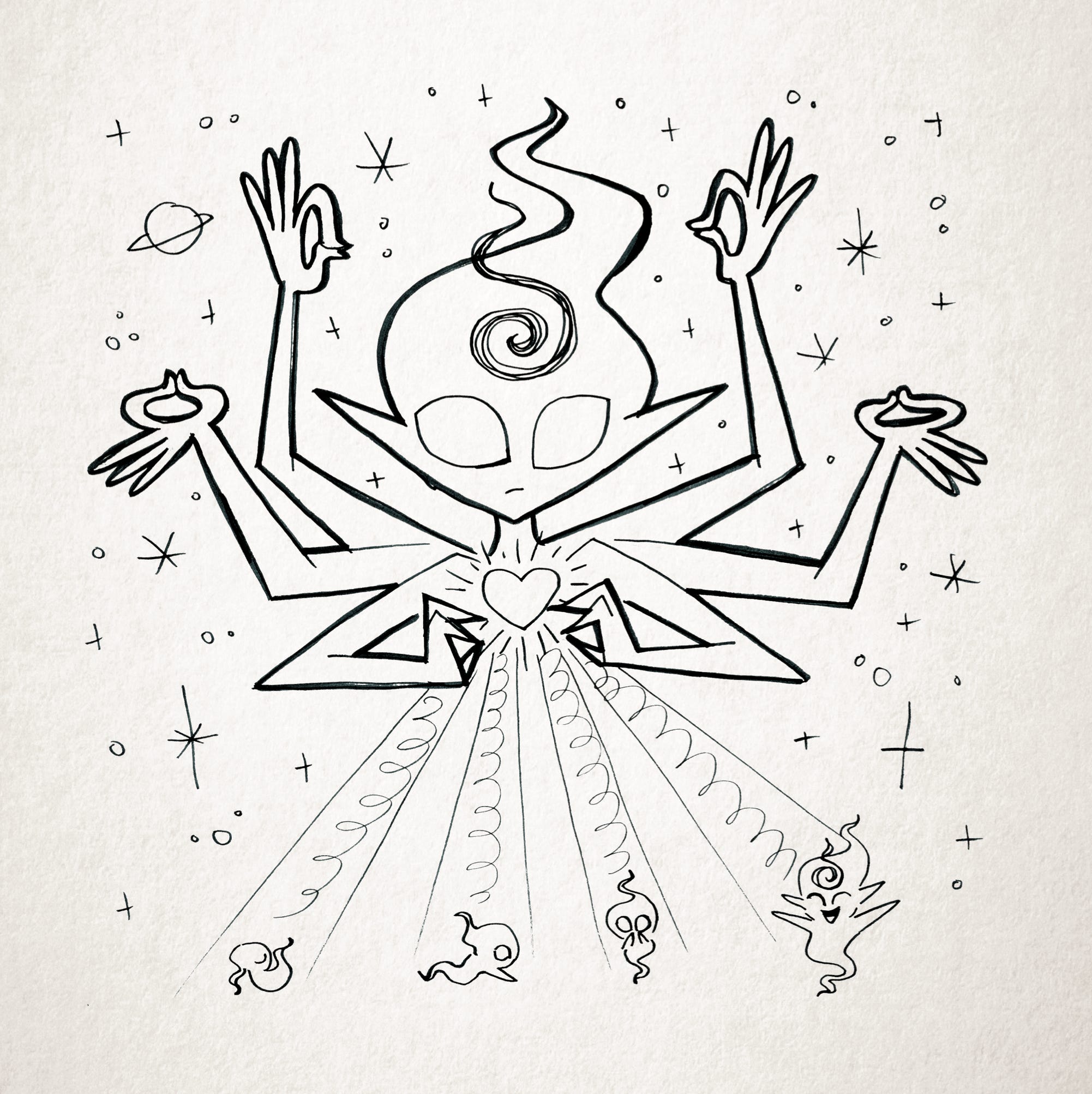
In this next practice, we will learn to give our Muse a form so we can learn how to recognize it. When inspiration calls, we will have a name for it. When it feels distant, we can invite it to join us. The more we know our creative spirit, the less mysterious it becomes, and the more collaborative our creativity feels.
Find a place of stillness. Close your eyes and take three slow breaths. In your mind’s eye, imagine your creative spirit approaching you. Do not force a shape, only take note of what arises. Is it light or dark? Bold or gentle? Playful or wise? Observe closely the characteristics that come through. Then ask it, “what is your name?”
Take out your journal or sketchbook. Write down the first word, sound, or image that comes to you.
Describe or draw your muse.
Note its energy, shape, and color(s).
Write how it feels to you, when it is near.
Record how it signals its arrival.
Channel any creative message it has for you
Creativity is not a performance. It is a partnership. We do not chase our Muse, instead we nurture it. When we learn to amuse our Muse, we discover that magic was never outside us. It was only waiting for us to play.